Wednesday, 25 May 2022

Today is World Otter Day

Today is World Otter Day.


However, every day should be World Otter Day to celebrate these amazing mammals!

It all started back in 2009 with Otterly Mad Week, a week of events, education and fun and in 2014 it became International Otter Awareness Day.

Finally, in 2016 it evolved into the IOSF World Otter Day on 27th May each year, a day designated to spread awareness of Otters and highlight some of the charities and organisations around the world dedicated to protecting the worlds Otters and their natural habitats.

Otters are carnivorous mammals in the sub-family Lutrinae. The 13 global Otter species are all semi-aquatic, aquatic or marine, with diets based on fish and invertebrates. Lutrinae is a branch of the Mustelidae family which also includes Weasels, Badgers, Honey Badgers, Martens, Minks, Polecats and Wolverines.

In the UK, Lutrinae is represented by the Eurasian Otter. It was effectively wiped out from much of it’s traditional range between 1950 to 1990 and it became restricted mainly to Scotland, especially the islands and the north west coast, west Wales, parts of East Anglia and the West Country. It is still a relatively rare but widespread species but it is now again found throughout the country although the largest populations still remain in the traditional strongholds.

The Otter is now protected in the UK under the Wildlife and Countryside Act 1981. It is also a priority species under the UK Post-2010 Biodiversity Framework, a European Protected Species under Annex IV of the European Habitats Directive and listed as Near Threatened on the global IUCN Red List of Threatened Species.

I have seen Otters in the UK on many occasions, almost exclusively in north and west Scotland where they can be seen reasonably easily (especially on the island of Mull) but I have also seen them at RSPB Strumpshaw Fen in Norfolk. In addition, I have seen captive animals at the British Wildlife Centre in Surrey.

Here are some of my photos of this beautiful and entertaining mammal:


Photo: Otter at Loch Scridain, Mull, Argyll, Scotland


Photo: Otter at Loch Scridain, Mull, Argyll, Scotland

Photo: Otter at Loch na Keal, Mull, Argyll, Scotland


Photo: Otter at Loch na Keal, Mull, Argyll, Scotland

Photo: Otter at Loch Scridain, Mull, Argyll, Scotland

Photo: Otter at Loch Scridain, Mull, Argyll, Scotland

Photo: Otter at Bunnahabhain, Islay, Argyll

Photo: Otter at Broadford Bay, Skye, Highland

Photo: Otter at Broadford Bay, Skye, Highland

Photo: Otter at Broadford Bay, Skye, Highland

Photo: Otter at RSPB Strumpshaw Fen, Norfolk

Photo: Otter at British Wildlife Centre, Surrey

Photo: Otter at British Wildlife Centre, Surrey

Photo: Otter at British Wildlife Centre, Surrey

Photo: Otter at British Wildlife Centre, Surrey

Photo: Otter at British Wildlife Centre, Surrey

Photo: Otter at British Wildlife Centre, Surrey

💚🦆 🦉🦋🐝🦊🦡🌼 🌳💚
Stay safe, stay well, stay strong, stay connected with nature

Monday, 23 May 2022

Our self-imposed international isolation

The life and times of Billy no-mates.

Our glorious position in the sunlit uplands of the post-Brexit world demonstrated in just one picture .... yes, that's us all alone in the top right hand corner having “taken back control”.

And this doesn't even begin to describe the immense economic, social and political damage that was predicted by so many and summarily dismissed as Project Fear by the illiterate, right-wing, nationalist head-bangers.


💚🦆 🦉🦋🐝🦊🦡🌼 🌳💚
Stay safe, stay well, stay strong, stay connected with nature

Sunday, 22 May 2022

Visit to St. Nicholas Church and surrounding areas – 22nd May 2022

Date: 22nd May 2022

Time: from 5:30 a.m.

Weather: dry, sunny, light wind, 11°C to 14°C

The main purpose of my visit this morning to the area surrounding St. Nicholas Church was to watch and photograph the local Red Foxes.

As on my previous visits dedicated to Red Fox photography on 3rd March 2022 and 7th April 2022, I didn’t just take my binoculars and camera but additionally the contents of a can of dog food and some dog biscuits and peanuts. Unfortunately, I completely forgot the remains of a chicken carcass so a full Red Fox “breakfast” was not on offer on this occasion 😀.

I accessed the site via the track from Larkins Tyres and then took the short track through the trees to my usual watchpoint overlooking the rough grass field bordered by scrub, hedges and trees. 

I climbed over the fence and walked across the field to the large oak tree where I left the food for the Red Foxes. I then returned to my watchpoint and made the first use of my newly purchased Walkstool as I waited for the Red Foxes to appear.

I waited …. and waited …. and waited …. and finally gave up after 2 hours. Clearly the absence of a chicken carcass as on my previous 2 visits made my offering far less attractive 😀.

However, I did see a Red Fox almost immediately after leaving home at the junction of Church Road and Basildon Road. When it spotted me, it just sat down in the road and looked in my direction. If it knew that I was carrying a “breakfast”, it should have followed me 😀.

The other mammal that I saw was a Reeves’ Muntjac at the end of the track to Larkins Tyres as I returned home.

With regard to birds, I did not walk around the whole site and my records solely relate to walking to and from the Red Fox watchpoint and at the watchpoint itself.

At the Red Fox watchpoint, I heard at least 3 singing male Blackcaps plus I had good but very distant views of another singing male Blackcap that repeatedly returned to the same song post at the top of one of the hedges. In addition, I heard 2 very distant singing male Chiffchaffs and a calling Stock Dove (only my second site record after the first during my visit on 1st May 2022) and saw both a fly-over Green Woodpecker and a fly-over Great Spotted Woodpecker.

After seeing the Reeves’ Muntjac, the area around Larkins Tyres proved to be very productive. In the scrub area behind Larkins Tyres, I saw a Common Buzzard initially on the ground and then in flight plus another male Blackcap and a Common Whitethroat, the latter continually singing and calling.

In the scrub immediately adjacent to the track by Larkins Tyres, I had several sightings of a male and female Common Whitethroat, both carrying food presumably to a nest site. This is exactly the same location where I saw a Common Whitethroat in both April of this year and last year. The same area also produced sightings of 2 more male Blackcaps.

Species recorded during this visit were as follows (heard only records in italics):

Common Whitethroat
Blackcap
Chiffchaff
Blue Tit
Great Tit
Robin
Wren
Dunnock
Blackbird
Greenfinch
Common Buzzard
Green Woodpecker
Great Spotted Woodpecker
Magpie
Carrion Crow
Stock Dove
Collared Dove
Woodpigeon
Lesser Black-backed Gull

Red Fox
Reeves’ Muntjac

Site totals to date (2022 totals in brackets):

Birds = 57  (39)
Mammals = 6  (3)
Butterflies = 21  (2)
Dragonflies and damselflies = 7  (0)
Reptiles = 1  (0)
Amphibians = 0  (0)

💚🦆 🦉🦋🐝🦊🦡🌼 🌳💚
Stay safe, stay well, stay strong, stay connected with nature

Saturday, 21 May 2022

Trip away from SS15 – EWT Two Tree Island, Leigh-on-Sea, Essex

This morning, I had a short bus and train journey to Leigh-on-Sea followed by a short walk to EWT Two Tree Island.

EWT Two Tree Island is situated adjacent to the internationally protected Thames Estuary and it is a winter refuge for a huge diversity and abundance of winter wildfowl (most notably Dark-bellied Brent Geese) and waders plus a wide range of breeding and migrant birds during the rest of the year.

EWT Two Tree Island was reclaimed from the sea in the 18th century when a seawall was built around the saltmarsh and it was originally used for farming. It is now managed as a nature reserve.

Approximately 4 miles of trails, which are a mixture of gravel and grass paths, provide access through the grasslands and scrub areas. At the end of the western section of the reserve is a bird hide which overlooks a lagoon which provides a valuable habitat for roosting and breeding water birds. The eastern section is part of Leigh National Nature Reserve where the saltmarsh is one of the best surviving in the Thames Estuary.

My last 2 visits to EWT Two Tree Island were both in April 2011 so a follow up visit was long overdue. During those previous visits there was a particularly showy Grasshopper Warbler, a normally skulking locustella warbler species that is very difficult to see even if you are able to hear its extraordinary continuous “reeling” song. Unfortunately, on this visit, I neither heard nor saw a Grasshopper Warbler. This is the bird that I photographed in April 2011 ....


Photo: “reeling” male Grasshopper Warbler

Whilst failing to record Grasshopper Warbler, I was able to see and/or hear 37 species, of which the highlights were as follows: Cuckoo (1 calling male seen plus 2 other calling males heard), Swift (5), Swallow (2), Common Whitethroat (16 singing males seen, at least 5 other singing males heard, 6 other birds seen ), Reed Warbler (1 singing male seen, at least 5 other singing males heard, 2 other birds seen), Blackcap (3 singing males seen plus at least 3 others heard), Chiffchaff (1 singing male heard plus at least 5 others heard), Cetti's Warbler (5 singing males heard), Reed Bunting (male), Sparrowhawk (female), Greenfinch (5), Avocet (10), Oystercatcher (11), Common Redshank (2), Dunlin (1), Common Tern (2), Mallard (12), Shelduck (2), Little Egret (1), Little Grebe (1), Canada Goose (8), Moorhen (7), Coot (5 including 1 juvenile)

The hide overlooking the lagoon provide the main photo opportunities, including a Common Whitethroat in the bushes right outside, whilst a very showy and noisy Reed Warbler also provided excellent photo opportunities from one of the hides in the western section.


Photo: Common Whitethroat


Photo: male Reed Warbler


Photo: male Reed Warbler


Photo: male Reed Warbler


Photo: male Reed Warbler


Photo: male Reed Warbler

Here are the rest of my photos from my visit ....


Photo: Oystercatcher


Photo: Oystercatcher


Photo: Oystercatcher


Photo: Oystercatcher


Photo: Oystercatcher


Photo: Oystercatcher


Photo: Oystercatcher


Photo: Oystercatcher


Photo: Oystercatcher


Photo: Oystercatcher


Photo: Avocet


Photo: Avocet


Photo: Avocet


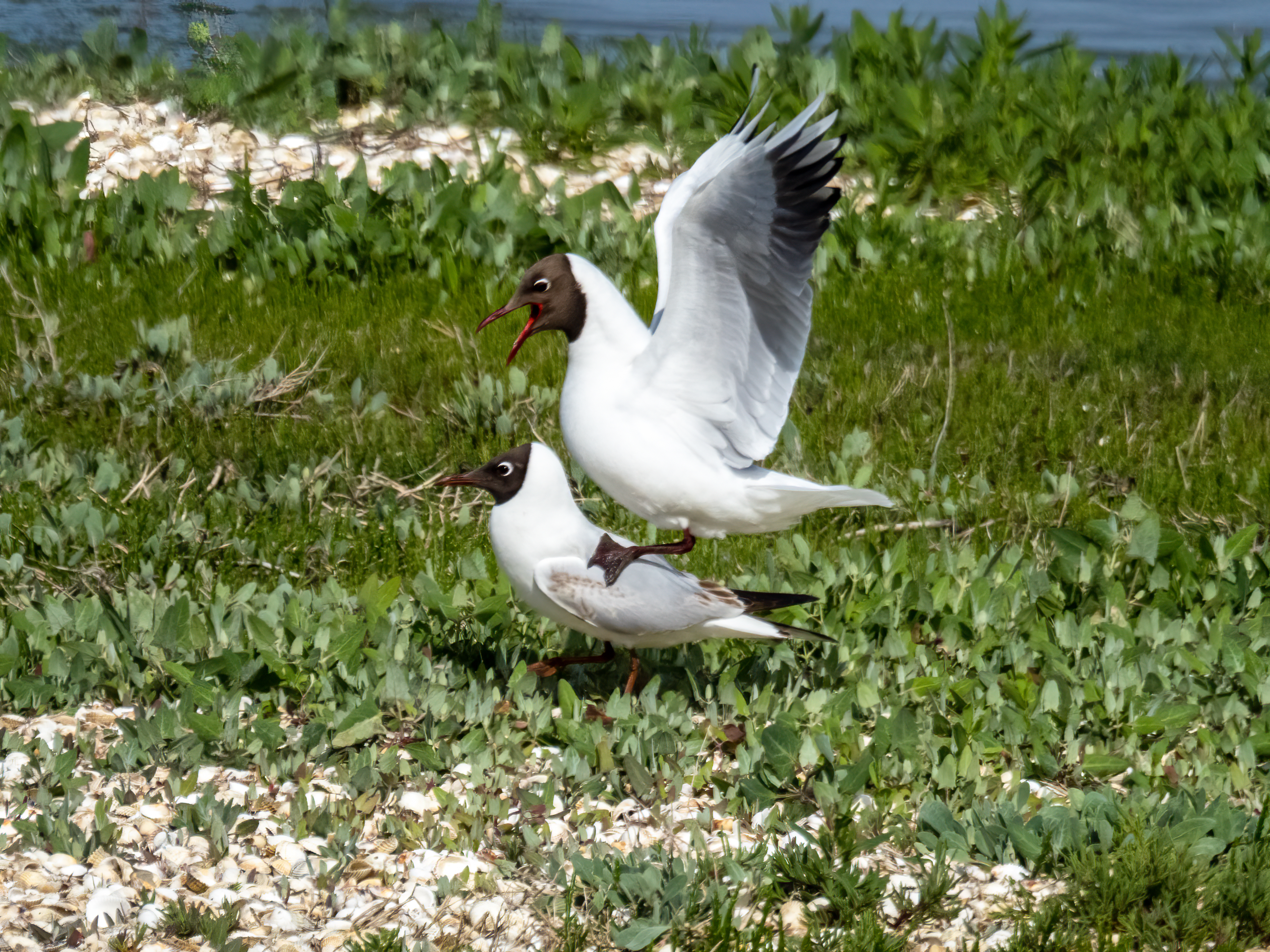
Photo: Black-headed Gulls


Photo: Black-headed Gulls


Photo: Black-headed Gulls


Photo: Black-headed Gull


Photo: Black-headed Gulls


Photo: male Mallard


Photo: male and female Mallard


Photo: Moorhen


Photo: Little Egret


Photo: view of Hadleigh Castle (English Heritage - Hadleigh Castle) from the western end of the reserve

Following my 3.5 hour walk of several miles around both the eastern and western sections, I made my way back to Leigh-on-Sea, specifically to The Crooked Billet in Leigh-On-Sea - Nicholson’s Pubs (nicholsonspubs.co.uk) for some well-earned Adnams real ale plus an excellent steak pie.

💚🦆 🦉🦋🐝🦊🦡🌼 🌳💚
Stay safe, stay well, stay strong, stay connected with nature