This blog was set up in mid-March 2020 during the COVID-19 health crisis in the UK and aimed to provide records of wildlife sightings and photos from sites within walking distance of my home in the SS15 postcode area of Basildon in Essex during lockdown travel restrictions.
This blog continues to include my local wildlife sightings, my trips away from home plus some personal thoughts and reflections on other issues.
NOTE: Format best viewed on a laptop/desktop PC rather than a mobile phone.
I see Grey
Squirrels regularly at both my local patch sites and around my block of
flats. The boundary
fence to the rear communal garden to my block of flats seems to be a
regular Grey Squirrel highway or resting point.
This morning I
saw a Grey Squirrel feeding on what appeared to be the remains of a half
coconut! I have no idea where he found this. At one point, he seemed very keen
to show me there was very little remaining inside the shell ….
Eventually he gained
the interest of another Grey Squirrel who took over his position on the fence ….
…. whilst he
retreated with his prize to the top of the adjacent garages ….
#DefendNature
#RestoreNatureNow
Please help save and enhance our laws that protect our environment and wildlife
💚🦆🦉🦋🐝🦊🦡🌼🌳💚
Stay safe, stay well, stay strong, stay connected with nature
Chris Packham has filed a High Court legal challenge to the UK government over its decision to weaken key climate policies.
Well done Chris! .... you will have a huge amount of support in taking on the hypocrisy and complete failure of the UK Government to respond to the climate emergency and biodiversity crisis facing our country and the world.
“Photography
is a kind of hunting. It is the hunting instinct without the desire to kill. It
is for angels… You stalk, you aim, you shoot, and click! Instead of killing
something, you have made it eternal.” - Chris Marker
#DefendNature
#RestoreNatureNow
Please help save and enhance our laws that protect our environment and wildlife
💚🦆🦉🦋🐝🦊🦡🌼🌳💚
Stay safe, stay well, stay strong, stay connected with nature
NatureScot has approved a licence application from the Cairngorms National Park to release up to 6 Beaver families at agreed sites in the upper River Spey catchment.
The approval marks the 5th catchment area to which Beavers have either been officially granted permission to remain or have been released. Populations are already established in Tayside, on the Forth, in Knapdale and Loch Lomond.
We're looking forward to beavers becoming established in the River Spey, a catchment that is assessed as highly favourable for beavers, bringing many biodiversity benefits. We will also work with the park to help farmers and crofters with any potential conflicts that may arise. https://t.co/iMnH6AEuwj
Congratulations @cairngormsnews for obtaining a licence to reintroduce beavers. This decision has been a long time coming despite majority support; we hope locals and visitors can soon enjoy seeing these industrious creatures shaping the wetlands of the Cairngorms.🦫 pic.twitter.com/dgXDORAnv3
Beavers are coming back to the Cairngorms!@naturescot has today approved a licence application from @cairngormsnews to release up to six beaver families at agreed sites in the upper River Spey catchment. pic.twitter.com/SPSVxmOFoh
When is the progressive and
enlightened ambition in Scotland going to be eventually matched in England and
Wales where progress by the Westminster Government in re-introducing Beavers is painfully
slow for no apparent reason?
I booked a rental car from 25th to 28th November 2023
for a trip away from home to include visits to a number of sites in Kent,
Essex, Suffolk and Norfolk.
The main purpose of my trip was to add further species to my 2023
UK year list before the end of December 2023 although I do plan a further
trip before the year end.
This trip was successful and I added the following target species
to my 2023 UK year list, these 8 species taking the total to 202 species
for the year to date: Short-eared Owl, Canvasback, Velvet
Scoter, Scaup, European White-fronted Goose, Barnacle
Goose, Waxwing, Common Crane (heard only)
The Canvasback sighting atEWT Abberton Reservoir was especially notable, this very rare duck from North
America having only been seen on less than 10 occasions in the UK. This was my
third UK record following 2 previous records at EWT Abberton Reservoir in Essex in November
1999 and at Lade Pits in Kent in February 2000
Unfortunately, I failed to record 3 other target species during my trip: Black-throated
Diver, Slavonian Grebe, Purple Sandpiper
Saturday 25th November 2023
After picking up my rental car and driving home, I then drove to RSPB Dungeness in Kent.
Dungeness is a headland on the south east coast of Kent formed largely of a shingle beach in the form of a cuspate foreland. It shelters a large area of low-lying
land, namely Romney Marsh. It is one of the largest expanses
of shingle in Europe and is of international conservation importance for itsgeomorphology, plants, invertebrates and
birds. This is recognised and protected mostly through its designations as a National Nature Reserve (NNR),
a Special
Protection Area (SPA), a Special Area of
Conservation (SAC) and part of the Site of Special
Scientific Interest(SSSI) of Dungeness,
Romney Marsh and Rye Bay.
RSPB Dungeness is part of the wider Dungeness area
and comprises a huge area of shingle, freshwater
pits, wet and dry grassland and wildflower meadows. During the winter months,
it is particularly important for large numbers of dabbling and diving ducks
plus some of the rarer grebes and divers.
During my visit, I failed to locate the Black-throated Diver
and Slavonian Grebe, both of which had been reported in the days prior
to my visit, but I did have very close views of 2 Great Northern Divers
which also enabled me to get my first ever photos of this species.
For many years, RSPB Dungeness was a reliable site for 20 to 30 Smew during the winter months but this
species has declined to typically single figure numbers and this winter, to
date, none have been reported.
The notable records from my visit were as follows: Great Northern Diver (2), Great White Egret
(2), Lapwing (++), Golden Plover (c.100), Teal (+++), Gadwall
(++), Shoveler (++), Tufted Duck (++), Common Pochard
(c.30), Goldeneye (5), Coot (+), Great Crested Grebe (4), Cormorant
(c.500), Canada Goose (++), Greylag Goose (++), Egyptian Goose
(1), Mute Swan (4), Great
Black-backed Gull, Lesser Black-backed Gull, Herring Gull, Kingfisher
(1), Marsh Harrier (3), Chiffchaff (1 seen and another heard
calling), Cetti’s Warbler (1 singing male heard)
RSPB Wallasea Island is a huge reserve
covering more than 740 hectares. It comprises former arable farming land which
has been transformed in to saltmarsh, mudflats, lagoons and grazing marsh.
To create this magical landscape, more than 3 million tonnes
of earth was brought by boat from the tunnels and shafts created by the
Crossrail scheme in London. This allowed the land to be raised above sea level
and place the soil in a way that created a new 115-hectare intertidal area of
saltmarsh, islands and mudflats known as Jubilee Marsh. In addition, Crossrail
helped create saline lagoons, a creek network and grazing marsh.
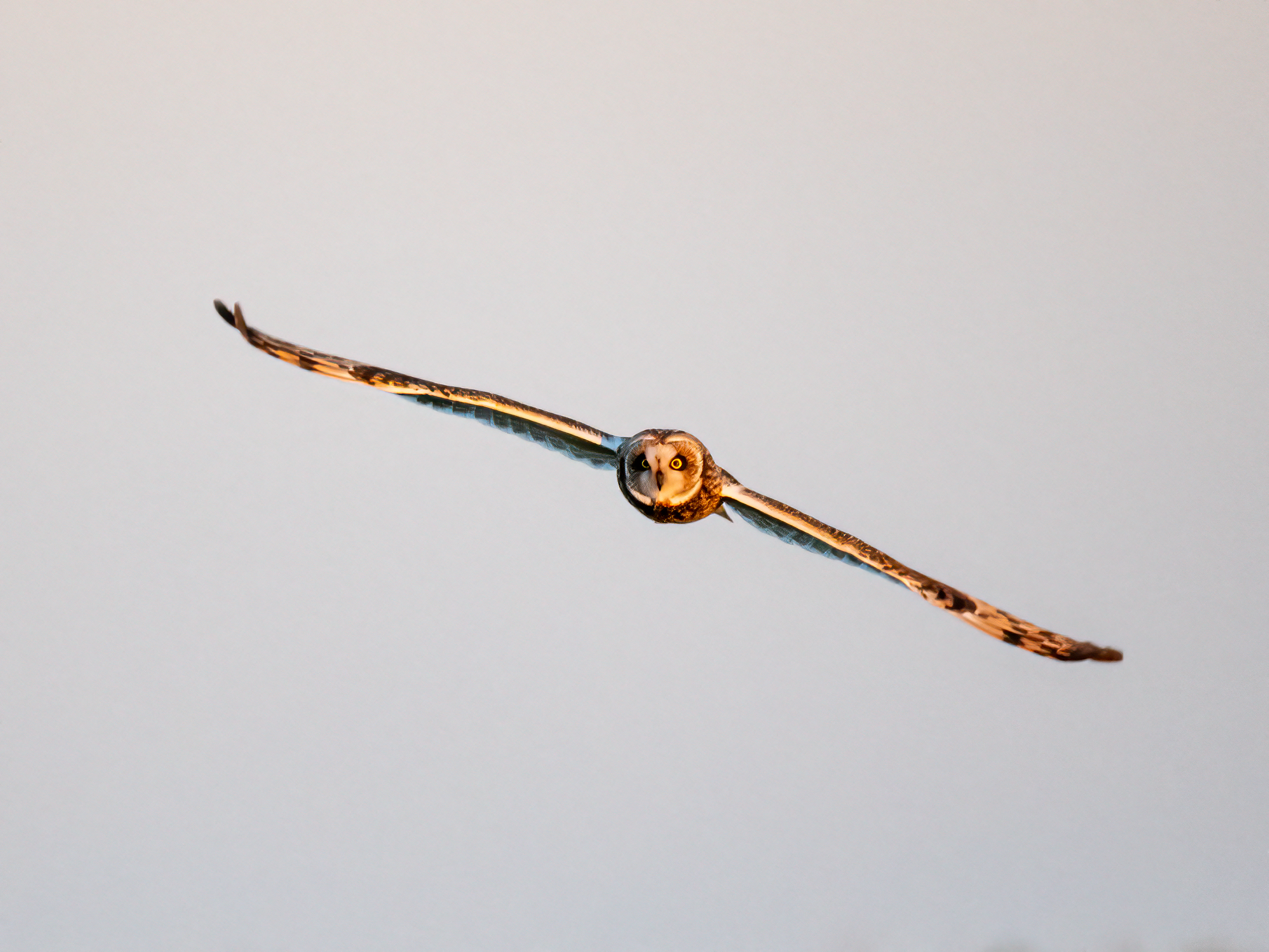
My main target species at RSPB Wallasea Island was Short-eared Owl.
This is a reliable site for this species, along with many other raptor species
during the winter months. This winter is proving to be an exceptionally good
one for wintering Short-eared Owls in the UK and RSPB Wallasea Island has not been exempted from the influx with up to 10 birds
being reported on most days.
I
had only just passed through the entrance gate to the reserve when I saw my
first Short-eared Owl, this being the first addition to my 2023 UK
year list of this trip. The directional sunlight was not great for photography
so I went back out of the reserve and along a short track which provided a
much better view and much better lighting conditions. Over the next hour or so,
I was able to watch at least 2 Short-eared Owls which provided exceptionally close views as they hunted plus some excellent photo opportunities.
As I arrived at this location, I recognised Steve Hedges. I have followed his highly recommended YouTube channel for over 2 years now after first seeing his video
from EWT Blue House Farm. Steve lives
relatively close to me but this was the first time that I had seen him out and
about in Essex. After saying “hello”, we had a chat, albeit interrupted regularly
by hunting Short-eared Owls.
The huge expanse of EWT Abberton Reservoir is
one of Europe's top wetland sites. It is of international importance as a safe
haven for wild ducks, swans and other water birds, whether resident, passing
through on migration or over-wintering.
My
main target species at EWT Abberton Reservoir were the Canvasback
plus Velvet Scoter and Scaup, all of which were being reported regularly
in the days prior to my visit. I successfully added all 3 species to my 2023 UK
year list.
I first found the 3 juvenile Velvet Scoters
and a single female Scaup by scanning through the large flock of Tufted
Ducks off the Abberton Church viewpoint. The Canvasback was
typically associating with a flock of Common Pochards off the
Layer-de-la-Haye causeway but it did take some time to locate it.
Unfortunately, I was unable to get any photos of these species due to the
distances involved and/or the lighting conditions.
The notable records from my visit were as
follows: Canvasback (1 male), Velvet Scoter (3 juveniles), Scaup
(1 female), Goosander (5 females), Tufted Duck (++++), Common
Pochard (+++), Goldeneye (c.100), Wigeon (c.50), Shoveler
(c.50), Gadwall (c.30), Teal (c.20), Mallard (c.10), Great
Crested Grebe (c.100), Cormorant (c.100), Mute Swan (c.30), Greylag
Goose (c.150), Egyptian Goose (5), Coot (++++), Moorhen
(1), Great White Egret (2), Little Egret (1), Common Redshank
(2), Lapwing (2), Common Buzzard (1), Raven (1 heard
calling car park from the Abberton Church viewpoint), Fieldfare (3), Cetti’s
Warbler (1 singing male heard), Red Fox (1 crossed the path on returning
to the car park from the Abberton Church viewpoint)
RSPB North Warren is located on the Suffolk coast and is
a patchwork of grazing marshes, reedbeds, heathland and woodland. During the
winter months, the grazing marshes hold large numbers of ducks, swans and
geese.
I spent a short time scanning the northern end of the grazing marshes
specifically for European White-fronted Geese and Barnacle Geese.
I successfully added both to my 2023 UK
year list with c.20 of the former and c.75 of the latter. Somewhat surprisingly,
I also saw 10 Red Deer crossing the grazing marshes.
Before moving on up to the north east coast of Norfolk, I
visited Ness Point in Lowestoft. Being largely
a coastal industrial area, it has nothing to recommend it scenically although
it is significant in being the most easterly point in the UK. It is also well
known amongst birders as being a very reliable site (usually) for Purple
Sandpipers in winter. This species is a relatively scarce winter
visitor to the UK from their Arctic breeding grounds.
My main target species was indeed Purple
Sandpiper which I had yet to add to my 2023 UK year list. Unfortunately, as
in January 2023, I was unsuccessful in finding any but I did see 5 Turnstones
and a single Rock Pipit.
Nearby in Lowestoft, I visited a residential area
where a flock of Waxwings had been reported regularly
in the days prior to my visit. It seems like this is going to be a good “Waxwing
winter” with several flocks now being reported in Suffolk and Norfolk after the
initial influx in to north east Scotland and north east England.
I successfully found the Lowestoft flock of Waxwings with this species being a further addition to my 2023 UK year list. I did get some
record photos although the light was very grey and dismal and therefore unfortunately didn't show off these beautiful birds at their best.
NWT Hickling Broad and Marshes is
the largest of the Norfolk Broads and is a year-round haven for wildlife and
holds a significant percentage of the UK population of Common Crane as
well as important breeding numbers of Bittern, Marsh
Harrier and BeardedTit. In winter, large numbers
of Marsh Harriers roost in the reedbed north east of Stubb
Mill and Hen Harrier, Merlin and Barn Owl can
also often be seen. Interesting mammals include the introduced Chinese
Water Deer plus Red Deer and Otter.
I spent around 2 hours at the Stubb Mill viewpoint
and stayed until it was almost completely dark (a torch is recommended for the long walk back to the car park!).
My main target species at NWT Hickling Broad and Marshes
was Common Crane which I had failed to see here in January 2023. Again, I didn’t see any Common Cranes but I did hear their distinctive bugling
call on several occasions. The main highlight for me was a male Hen Harrier
whilst other birders picked up a Merlin from the viewpoint and flushed a Woodcock
on the walk back to the car park.
The
notable records from my visit were as follows: Common Crane (at
least 1 bird heard calling), Hen Harrier (1 male), Marsh Harrier (at
least 20 coming in to roost), Barn Owl (1), Common Buzzard (1),
Kestrel (1), Great White Egret (1), Pink-footed Goose (++++), Red Deer (1), Chinese
Water Deer (1)
Monday 27th November 2023
After
staying overnight at Travelodge Great-Yarmouth Acle,
it had been my plan to spend the day on the north Norfolk coast, However, I
woke up to heavy rain which was forecast to continue all day across East
Anglia.
Therefore,
I decided to drive home although I did drop in again at Ness Point in
Lowestoft in the hope that there would be some Purple Sandpipers …. there weren’t
…. although the Turnstone flock had increased to c.25.
Although this was a disappointing end to my trip, I was pleased
to add 8 species to my 2023 UK year list, including
the exceptionally rare Canvasback,plus get my first ever photos
of Great Northern Diver and my best ever photos of Short-eared Owl.
#DefendNature
#RestoreNatureNow
Please help save and enhance our laws that protect our environment and wildlife
💚🦆🦉🦋🐝🦊🦡🌼🌳💚
Stay safe, stay well, stay strong, stay connected with nature