Monday, 13 September 2021

Record from my flat - Green Woodpecker, Jay and Grey Squirrel

I had to walk in to Basildon town centre this afternoon.

As I left my flat to walk down the grassy strip to the main road, I immediately saw the colourful spectacle of a Green Woodpecker and a Jay both foragaing on the ground close together. Both quickly saw me and flew off calling.

When I returned the same way, I saw a Grey Squirrel, also on the ground before it ran off into the trees.

💚🦆 🦉🦋🐝🦊🦡🌼 🌳💚
Stay safe, stay well, stay strong, stay connected with nature


Sunday, 12 September 2021

Visit to St. Nicholas Church and surrounding areas – 12th September 2021

Date: 12th September 2021 

Time: from 7:30 a.m.

Weather: dry, hazy sunshine, light wind, 12°C to 14°C

This was my first visit to the site in over 2 weeks.

Immediately on leaving the communal exit to the flats where I live, I heard a distant “barking” male Reeves’ Muntjac. During the last week or so, I thought I heard this deer “barking” briefly on 2 other occasions late at night although I could not be certain.  

I accessed the site via the track from Larkins Tyres and, as I did so, a Reeves’ Muntjac sprang out from the scrub to the side of me and ran off down the track, holding its wide tail erect and displaying its white underside, a characteristic sign when this species is disturbed or alarmed.

During my visit, I saw another Reeves’ Muntjac when I was sat at St. Nicholas Church. It slowly crossed the grassy area immediately beyond the car park to disappear in to the wooded area but several minutes later presumably the same individual emerged on the other side to cross Church Hill and again disappear.

After seeing the first Reeves’ Muntjac, I saw a Grey Squirrel in the same area and then another in the western section of the cemetery.


Photo: Grey Squirrel

Whilst sat at St. Nicholas Church, I saw 2 Red Foxes cross Church Hill in quick succession.

It continues to be relatively quiet with regard to birds although there were several highlights during my visit.

The most notable sighting was from my usual watchpoint overlooking the field, scrub and wooded area in the north of the site. A Common Buzzard flew in pursued by several Magpies and landed and perched at the top of one of the hedges. It was continually harassed by Magpies for around 10 minutes before it flew off in a westerly direction only to return almost immediately, still pursued by Magpies, and then head in a south easterly direction towards my flat.


Photo: heavily cropped record shot of distant Common Buzzard

From this viewpoint, I also heard an almost continually but distantly calling Chiffchaff and, on a few brief occasions, this bird or another, broke in to song although by no means as loud and robust as in spring. In addition, I heard the brief alarm calling of a Blackcap in the same area. I failed to see either species but evidently both of the common summer visiting and breeding warblers are still present.

The only other notable records were 2 calling Great Spotted Woodpeckers (1 around St. Nicholas Church and 1 in the wooded area adjacent to the viewpoint) and 2 fly-over Canada Geese heading in an easterly direction and also seen from the watchpoint.

In another sign that autumn is here, Robins are singing again regularly around the site and Jays have become far more conspicuous and noisy as they go about their acorn foraging trips.

Species recorded during this visit were as follows (heard only records in italics):

Blackcap
Chiffchaff
Blue Tit
Great Tit
Long-tailed Tit
Robin
Wren
Common Buzzard
Great Spotted Woodpecker
Jay
Magpie
Carrion Crow
Woodpigeon
Collared Dove
Herring Gull
Canada Goose

Red Fox
Reeves’ Muntjac
Grey Squirrel

Site totals to date (2021 totals in brackets):

Birds = 53  (42)
Mammals = 6  (5)
Butterflies = 21  (14)
Dragonflies and damselflies = 7  (2)
Reptiles = 1  (0)
Amphibians = 0  (0)

💚🦆 🦉🦋🐝🦊🦡🌼 🌳💚
Stay safe, stay well, stay strong, stay connected with nature


Saturday, 11 September 2021

It's my birthday ....

CR7 made his second debut and scored 2 goals and Man United won 4-1 and went to the top of the Premier League .... that was some present!


💚🦆 🦉🦋🐝🦊🦡🌼 🌳💚
Stay safe, stay well, stay strong, stay connected with nature


Tuesday, 7 September 2021

RSPB Blacktoft Sands - White-tailed Lapwing

A White-tailed Lapwing was reported at Stodmarsh and Grove Ferry NNR in the Stour Valley in Kent on 2nd June 2021 …. see here.

What is believed to be the same bird turned up at RSPB Blacktoft Sands in East Yorkshire on 26th August 2021 and remains there as at 23rd September 2021 when I was retrospectively writing my trip report in respect of my visit on 6th September 2021 …. see here.

This is only the 12th record of this exceptionally rare bird in the UK. The last was in 2010, a famous, well-twitched White-tailed Lapwing that toured multiple sites in Lancashire, London, Gloucestershire and Kent during the summer of that year. I saw this individual at RSPB Dungeness in Kent on 17th July 2010 and only managed very poor long-distance record photos.


Photo: record shot of White-tailed Lapwing at RSPB Dungeness, Kent

On 6th September 2021, I visited RSPB Blacktoft Sands and had exceptional views of this latest White-tailed Lapwing to visit the UK plus I achieved some rather better photographic results.

When I first arrived in the Xeros Hide, the White-tailed Lapwing was asleep on a small island in the lagoon amongst some Mallard and Teal but it was instantly recognisable.


Photo: White-tailed Lapwing at RSPB Blacktoft Sands, East Yorkshire

Occasionally, it did the decent thing for the eagerly waiting birders and woke up!


Photo: White-tailed Lapwing at RSPB Blacktoft Sands, East Yorkshire

After some time a fly through female Sparrowhawk shook things up and most of the birds, including the White-tailed Lapwing, took to the air in panic.

After a few minutes, it all settled down again and the White-tailed Lapwing provided much better views out in the open shallow lagoon.


Photo: White-tailed Lapwing at RSPB Blacktoft Sands, East Yorkshire


Photo: White-tailed Lapwing at RSPB Blacktoft Sands, East Yorkshire

It eventually returned to the same island although it was not joined by its previous companions.


Photo: White-tailed Lapwing at RSPB Blacktoft Sands, East Yorkshire


Photo: White-tailed Lapwing at RSPB Blacktoft Sands, East Yorkshire


Photo: White-tailed Lapwing at RSPB Blacktoft Sands, East Yorkshire

The White-tailed Lapwing or White-tailed Plover is a wader in the lapwing genus Vanellus. It is long-legged and fairly long-billed. Adults are slim erect birds with a brown back and fore-neck, paler face and grey breast. Its long yellow legs, pure white tail and distinctive brown, white and black wings make it unmistakable.

The White-tailed Lapwing breeds semi-colonially on inland marshes, flooded fields and lake and river banks in Iraq, Iran and southern Russia. The Iraqi and Iranian breeders are mainly residents but Russian birds migrate south in winter to the Indian sub-continent, the Middle East and north east Africa. It is an extremely rare vagrant in western Europe.

BirdGuides - White-tailed Lapwing


💚🦆 🦉🦋🐝🦊🦡🌼 🌳💚
Stay safe, stay well, stay strong, stay connected with nature


Trip away from SS15 – Essex, Norfolk, Lincolnshire and East Yorkshire

I booked a rental car from 4th September 2021 to 7th September 2021 for a trip away from home and visits to a number of sites.

My trip provided excellent birding opportunities, especially the sighting of an exceptionally rare White-tailed Lapwing plus 3 further additions to my UK year list for 2021 (Cattle Egret, Little Stint and Water Rail).

4th September 2021

On 4th September 2021, apart from catching up on various things that required a car, I had a brief visit to Wat Tyler Country Park in Pitsea to hopefully see the Cattle Egrets that were being reported regularly there. These typically southern European herons are being seen in the UK in increasing numbers and this seems to be a sustained range expansion with the species now breeding, albeit very rarely.

I have seen large numbers of Cattle Egrets in southern Europe but I had my first UK record at Blythburgh in Suffolk in September 2001 when the species was still very much a rare vagrant. From 2014, I have recorded Cattle Egret every year for my UK year list, including previously at Wat Tyler Country Park in September 2017.

My visit to Wat Tyler Country Park on 4th September 2021 proved to be successful and it was very easy to see 4 Cattle Egrets moving across the saltmarsh on the other side of Timbeman’s Creek. Whilst watching these birds, I had the unexpected and welcome sighting of a Spoonbill flying through. Cattle Egret was an addition to my UK year list for 2021 but I had already previously recorded Spoonbill.

The Cattle Egrets were too distant for photos but here are some that I have taken in Spain ....


Photo: Cattle Egret at Delta de l'Ebre, Catalunya, Spain


Photo: Cattle Egret at Delta de l'Ebre, Catalunya, Spain


Photo: Cattle Egret at El Guijo-Santa Eufemia, Andalucia, Spain


Photo: Cattle Egret at Corredor Verde dos Bahias near Benalup, Andalucia, Spain


Photo: Cattle Egret at Corredor Verde dos Bahias near Benalup, Andalucia, Spain


Photo: Cattle Egret at Corredor Verde dos Bahias near Benalup, Andalucia, Spain

5th September 2021

During late August and early September each year, I usually visit RSPB Titchwell Marsh in north west Norfolk and RSPB Frampton Marsh in east Lincolnshire, principally for the autumn return wader passage migration and specifically targeting Little Stint and Curlew Sandpiper as additions to my UK year list.

After an early start from home, I arrived at RSPB Titchwell Marsh at around 9:15 a.m.

Compared with previous years, my visit was slightly disappointing. However, after more than an hour and after much repeated scanning, I finally found a single Little Stint which was a further addition to my UK 2021 year list.

In addition to the Little Stint, I recorded the following wader species amongst the large numbers of eclipse ducks: Black-tailed Godwit (c.100), Avocet (c.50), Ruff (c.50), Dunlin (c.20), Ringed Plover (2), Lapwing (c.100) and Golden Plover (1). Unfortunately, I did not see the hoped for Curlew Sandpiper and nor did I see Spotted Redshank, Green Sandpiper, Wood Sandpiper or Common Sandpiper.

Other highlights at RSPB Titchwell Marsh included: Marsh Harrier (7 birds in the air together), Bearded Tit (several heard calling only), Chiffchaff (4 heard including 2 males still singing), Blackcap (2 heard alarm calling) plus several Ruddy Darters and Migrant Hawkers and Reeves’ Muntjac (2 “barking” males heard near the visitor centre).

Here are some photos of Ruffs from my visit ….


Photo: Ruffs at RSPB Titchwell Marsh


Photo: Ruff at RSPB Titchwell Marsh


Photo: Ruff at RSPB Titchwell Marsh


Photo: Ruff at RSPB Titchwell Marsh


Photo: Ruff at RSPB Titchwell Marsh


Photo: Ruff at RSPB Titchwell Marsh

6th September 2021

After staying overnight at Premier Inn Kings Lynn, it had been my plan to first visit RSPB Frampton Marsh in Lincolnshire and then move on to RSPB Blacktoft Sands in east Yorkshire for the White-tailed Lapwing that had been present for several days.

However, the early morning weather was not as had been forecast so I drove directly (albeit slowly due to the typically dreadful experience of the A17 in Lincolnshire) to RSPB Blacktoft Sands where I had a very successful visit.

Apart from seeing the exceptionally rare White-tailed Lapwing (see here), I recorded the following: Bittern (1 “booming” male heard on several occasions), Little Egret (13), Grey Heron (2), Little Stint (2), Greenshank (5), Green Sandpiper (3), Common Sandpiper (1), Ruff (c.30), Black-tailed Godwit (c.10), Ringed Plover (1), Common Redshank (2), Lapwing (c.20), Common Snipe (11) and Water Rail (1 heard only but another addition to my UK 2021 year list).

Other highlights at RSPB Blacktoft Sands included: Marsh Harrier (1), Common Buzzard (1), Sparrowhawk (1), Bearded Tit (c.10), Reed Bunting (1), Reed Warbler (3), Cetti’s Warbler (1 heard singing), Chiffchaff (1 heard calling) and several adult and juvenile Goldfinches feeding on thistles in front of one of the hides.


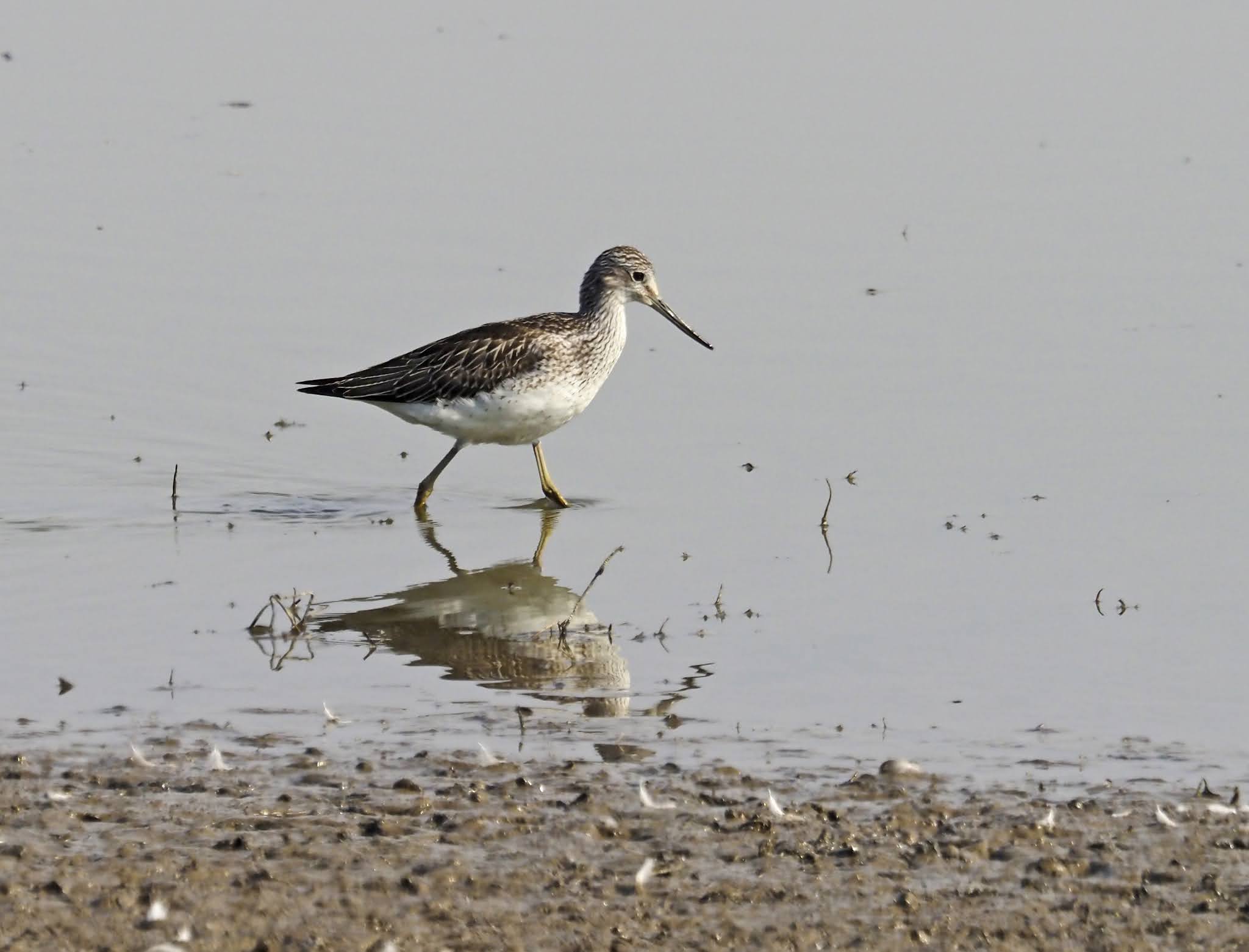
Photo: Greenshank at RSPB Blacktoft Sands


Photo: Greenshank at RSPB Blacktoft Sands


Photo: Greenshank at RSPB Blacktoft Sands


Photo: Greenshank at RSPB Blacktoft Sands


Photo: Common Snipe at RSPB Blacktoft Sands


Photo: Ruff at RSPB Blacktoft Sands


Photo: Ruff at RSPB Blacktoft Sands


Photo: Little Egrets at RSPB Blacktoft Sands


Photo: Little Egret at RSPB Blacktoft Sands


Photo: Little Egret at RSPB Blacktoft Sands


Photo: juvenile Goldfinch at RSPB Blacktoft Sands


Photo: juvenile Goldfinch at RSPB Blacktoft Sands


Photo: juvenile Goldfinch at RSPB Blacktoft Sands


Photo: juvenile Goldfinch at RSPB Blacktoft Sands


Photo: Goldfinch at RSPB Blacktoft Sands


Photo: Common Buzzard at RSPB Blacktoft Sands

After my visit to RSPB Blacktoft Sands, I returned south to RSPB Frampton Marsh in Lincolnshire.

Like RSPB Titchwell Marsh, my visit was slightly disappointing compared with previous years primarily due to the fact that the whole marsh surrounding the 360 degree hide was completely dried up. Normally, there is plenty of wet mud which proves to be a huge attraction to waders.

Nonetheless, other areas of the reserve did prove to be productive and I recorded the following: Spoonbill (20), Great White Egret (1), Little Egret (5), Little Stint (5), Greenshank (1), Ruff (4), Common Sandpiper (1), Dunlin (c.30), Black-tailed Godwit (c.100), Common Snipe (8), Avocet (1) and Lapwing (c.100).

Other highlights at RSPB Frampton Marsh included: Yellow Wagtail (7), Whinchat (1), Swallow (c.20) and, amongst the large numbers of eclipse ducks, c.10 early returning Wigeon.

Unfortunately, I failed to see the Black Stork that had been present for several days.

💚🦆 🦉🦋🐝🦊🦡🌼 🌳💚
Stay safe, stay well, stay strong, stay connected with nature