This blog was set up in mid-March 2020 during the COVID-19 health crisis in the UK and aimed to provide records of wildlife sightings and photos from sites within walking distance of my home in the SS15 postcode area of Basildon in Essex during lockdown travel restrictions.
This blog continues to include my local wildlife sightings, my trips away from home plus some personal thoughts and reflections on other issues.
NOTE: Format best viewed on a laptop/desktop PC rather than a mobile phone.
This year, I again participated in the Big Butterfly Count from 14th July to the 6th August 2023 .... see here.
However, I also recorded my butterfly sightings for all my spring and summer visits to my local patch sites at St. Nicholas Church and the surrounding areas and Noak Bridge Nature Reserve.
Anecdotally, despite some poor weather (especially for most of July), there seems to have been a greater abundance of butterflies this year compared with previous years.
In addition, the number of species that I have recorded this year significantly increased at St. Nicholas Church and the surrounding areas and was almost the same at Noak Bridge Nature Reserve:
St. Nicholas Church and the surrounding areas
Total number of species recorded at the site = 25
2021 = 15
2022 = 17
2023 = 23
Species recorded in 2023: Brown Argus, Comma, Common Blue, Essex Skipper, Gatekeeper, Holly Blue, Large Skipper Large White, Marbled White, Meadow Brown, Orange Tip, Painted Lady, Peacock, Purple Hairstreak, Red Admiral, Ringlet, Small Copper, Small Heath, Small Skipper, Small Tortoiseshell, Small White, Speckled Wood, Wall
Noak Bridge Nature Reserve
Total number of species recorded at the site = 22
2021 = 9
2022 = 15
2023 = 14
Species recorded in 2023: Brimstone, Brown Argus, Comma, Gatekeeper,
Holly Blue, Meadow Brown, Orange Tip, Peacock, Purple Hairstreak, Red Admiral,
Ringlet, Small Copper, Small White, Speckled Wood
Note: The absence of any records of Large Skipper, Small Skipper and Large White is surprising and I have no doubt that all 3 of these species were present at the site. Had I recorded them all, my species list for 2023 would have been 17 and higher than that for 2022.
Away from my local patches, a trip to Dorset in early July allowed me to record 21 butterfly species in just 3 days, including 5 new species for me: Lulworth Skipper, Grayling, Dark Green Fritillary, Small Blue, Silver-studded Blue.... seehere.
#DefendNature .... Please help save and enhance our laws that protect our environment and wildlife
💚🦆🦉🦋🐝🦊🦡🌼🌳💚
Stay safe, stay well, stay strong, stay connected with nature
Campaigners say that the UK is becoming the "toxic
poster child of Europe" and accuse the Government of breaking Brexit
promises on standards.
Shockingly,
but not surprisingly, the UK Government has failed to ban 36 pesticides that
are not allowed for use in the EU.
Although
the Government promised the UK would not water down EU-derived environmental
standards after Brexit, there have been multiple instances of
divergence since we left the EU.
The UK Government
is failing to phase out pesticides that have been found to be harmful to human
health and the environment at the same rate as the EU according to research
from Pesticide Action Network (PAN).
12 of the
36 chemicals have been classified as carcinogens, 9 have been found to be
endocrine disruptors which interfere with hormones and are linked to
infertility, 8 are developmental or reproductive toxins that have also been
linked to fertility problems, 2 are cholinesterase inhibitors that can impair
the respiratory system and 1 is classified as acutely toxic.
13 of the
36 chemicals are considered highly hazardous pesticides under UN definitions
used to identify the most harmful substances. Of these, 4 are highly toxic to
bees, 1 contaminates water and 1 is highly toxic to aquatic organisms.
30 of the
36 chemicals were allowed for use in the EU when the UK left on 31st January
2020 but have since been banned and the remaining 6 have been approved by the
UK Government but not the EU since then.
PAN is
calling for the UK Government to bring standards back in line with the EU to
protect human health, agriculture and the environment.
#DefendNature .... Please help save and enhance our laws that protect our environment and wildlife
💚🦆🦉🦋🐝🦊🦡🌼🌳💚
Stay safe, stay well, stay strong, stay connected with nature
I had a long overdue sighting of a Common Buzzard from my flat at 1:45 p.m. this afternoon with a single bird flying in from the south, circling a few times beyond the houses opposite and then flying off north.
This is my first record of a Common Buzzard from my flat since the last on 9th May 2023.
This follows a record at my St. Nicholas Church local patch site on 30th August 2023, the first there since 12th April 2023.
Between 12th March 2023 and 12th April 2023, I recorded Common Buzzards (either single birds or a presumed pair) on 6 visits to my St. Nicholas Church local patch site and it did appear that a pair was maybe settling down to breed. However, the absence of any records since 12th April 2023 definitely suggests that these birds moved on. I also had 5 sightings of Common Buzzards from my flat during March 2023.
It is therefore nice to see this raptor again in my local area although the number of sightings from my flat is very much reduced compared to 2022.
I have recorded Common Buzzard sightings from my flat since 2021. Sightings are, or at least were, increasing and last year I was almost convinced that there was a resident and possibly nesting pair in the area since I also frequently saw birds over my nearby local patch site around St. Nicholas Church.
This is the summary of my Common Buzzard sightings from my flat for the last 2 years ....
2021: 11 dates with those records involving 13 birds
2022: 26 dates with those records involving 38 birds
This is the summary of my Common Buzzard sightings from my flat for 2023 to date ....
February: 23rd (a single bird)
March: 11th (a single bird), 12th (a single bird), 18th March 2023 (a single bird), 19th March 2023 (a single bird), 30th March (a single bird)
September: 17th (a single bird)
2023 to date: 7 dates with those records involving 7 birds
#DefendNature .... Please help save and enhance our laws that protect our environment and wildlife
💚🦆🦉🦋🐝🦊🦡🌼🌳💚
Stay safe, stay well, stay strong, stay connected with nature
Overall,
participants in the Big
Butterfly Countenjoyed
seeing more butterflies this year than in the previous 4 summers. In total,
over 1.5 million butterflies and day-flying moths were recorded from 14th July
to 6th August 2023. After an all-time low in 2022 of just 9 individual
butterflies spotted per count, this year saw an increase to 12 butterflies
recorded on average per count.
However,
this good news is in contrast with what the long-term trends are revealing.
Released for the first time this year, these show that since the Big Butterfly Countstarted 13 years ago, many species have
significantly decreased.
It is a further warning sign that nature everywhere is in
crisis. Butterflies, as well as forming a vital part of the food chain, are
considered significant indicators of the health of the environment.
Following last summer’s heatwave and drought, scientists
at Butterfly
Conservation called on the public to help them
understand the effect the extreme weather had on the UK’s butterflies. People
responded in their thousands, with almost 95,000 citizen scientists taking part
in this year’s Big
Butterfly Count, conducting 136,719 15-minute counts in
gardens, parks, school grounds and the countryside.
Dr Zoe Randle, Senior Surveys Officer at Butterfly
Conservation, said: “It’s wonderful that so many people have been out enjoying
spotting butterflies. We had huge support for Big Butterfly Count this year,
and thanks to the many people who went out during those sunny intervals, we now
know that the effects of last year’s drought were not as bad for butterflies as
we had feared.
“The mixed weather this year has helped as there has been
an abundance of green food plants available for caterpillars, and plenty of
nectar-rich flowers for adult butterflies. However, while the number of
butterflies recorded this summer has been the highest since 2019, the
longer-term trends show worrying declines for some of the UK’s most common
butterfly species.”
The most-seen species this year was the Red
Admiral with 248,077 recorded, an increase of 338% on last year’s
count and the first time the species, which is increasing in the UK as a result
of climate change, has taken the top-spot.
Gatekeeper was
next with 222,896 sightings. This represents a 12% increase on last year and is
a small, but welcome, boost for a species that has decreased by 28% since the Big
Butterfly Count began.
The Whites took the third and fourth
spot, with 216,666 sightings of Large Whites and 190,506
of Small Whites, an 11% and 15% increase on 2022
respectively. Holly Blue had another good summer, with numbers
up 66% on 2022, in keeping with its longer-term Big
Butterfly Counttrend of a
41% increase.
Species that saw a decline from last year include Ringlet, Common
Blue and Speckled Wood, all of which also show long-term
declines.
Although its numbers hardly changed compared to summer
2022, Green-veined White has the most severe Big
Butterfly Counttrend in the
longer term with a decrease of 61%.
Dr Richard Fox, Head of Science at Butterfly
Conservation, explained: “One of the biggest threats butterflies
in the UK face is habitat loss. While the weather certainly has an impact on
numbers from year to year, butterflies, moths and many other species can
generally cope with variable weather. What they can’t cope with is habitat
destruction.
“Butterflies
need a place to live. If they can feed, breed and shelter, they can thrive. By
creating a Wild Space in your outdoor area you can help to reverse the massive
losses of wildlife-friendly habitat and start to turn around the fortunes of
our declining butterflies."
#DefendNature .... Please help save and enhance our laws that protect our environment and wildlife
💚🦆🦉🦋🐝🦊🦡🌼🌳💚
Stay safe, stay well, stay strong, stay connected with nature
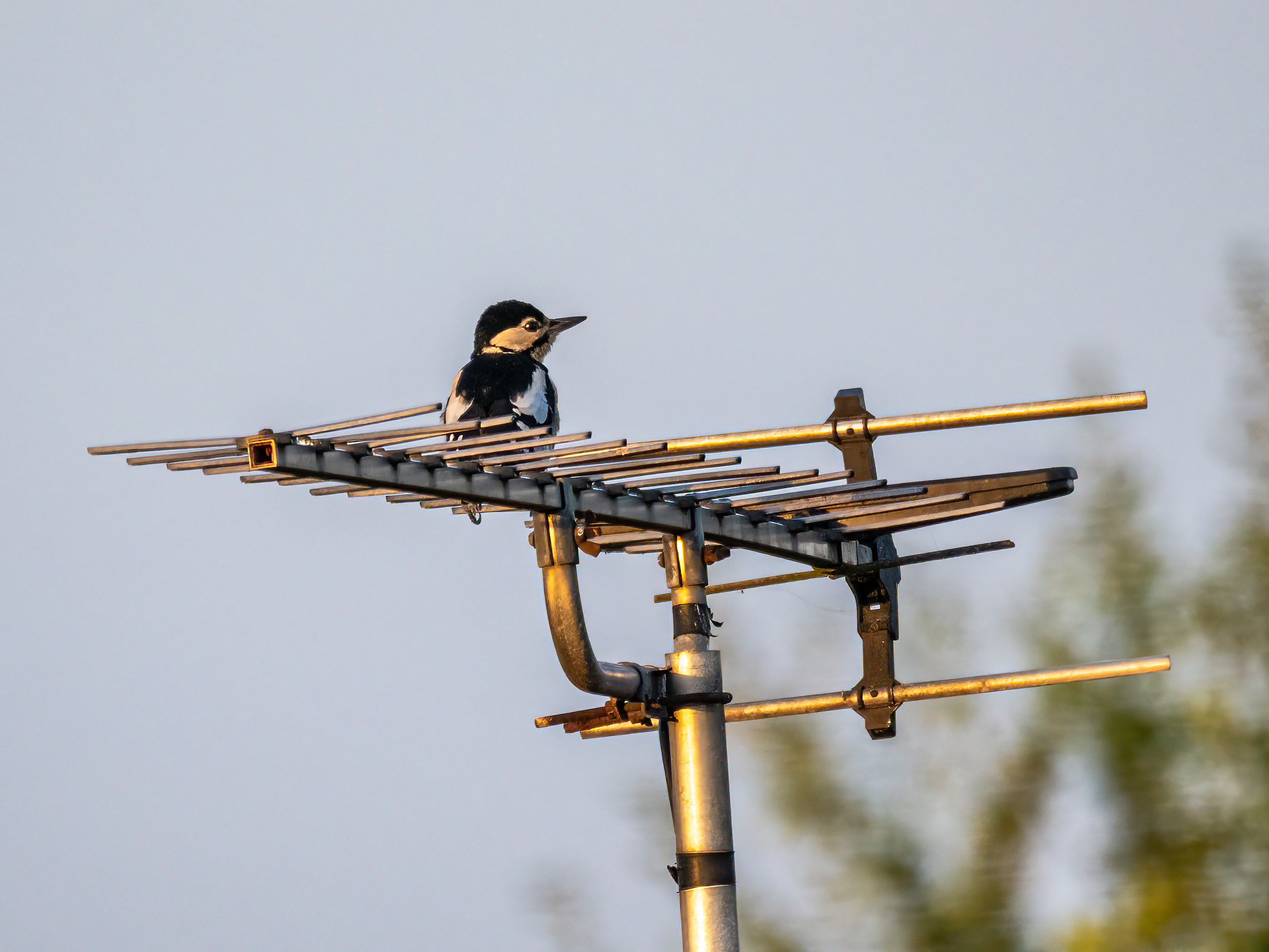
I often hear Great Spotted Woodpeckers calling from the wooded area adjacent to or close to my flat but I rarely see the birds.
This evening when I was in my kitchen, I heard a calling Great Spotted Woodpecker and quickly spotted it on top of the TV aerial on one of the houses. Clearly, it hadn't got the memo about calling from trees! However, after several minutes repeatedly calling from this location, it did eventually fly off to a nearby tree.
I didn't expect this bird to remain on the TV aerial for so long but it duly did so, thus enabling me to get some distant cropped record photos.
#DefendNature .... Please help save and enhance our laws that protect our environment and wildlife
💚🦆🦉🦋🐝🦊🦡🌼🌳💚
Stay safe, stay well, stay strong, stay connected with nature
Anecdotally,
I have known for most of my life that being outdoors enjoying and appreciating
the natural environment and wildlife is good for my physical and mental health
and my general well-being.
Now, according to a new report by
the Wildlife Trusts, nature-based health and well-being programmes
could save hundreds of millions of pounds each year and reduce society's
reliance on the NHS.
The report, entitled “A
Natural Health Service: Improving Lives and Saving Money”, found that green
prescribing can save more in healthcare costs than the price of running a green
prescribing scheme.
Green prescribing is an
evidence-based pillar of social prescribing that harnesses the health, well-being,
and social benefits of spending time in nature. It enables GPs and other health
care practitioners to refer people to nature-based programmes to improve
physical and mental health.
The new research, undertaken by
global strategic environmental and engineering consulting company, Ricardo plc,
and The Institute of Occupational Medicine Health, analysed 5 Wildlife Trusts
programmes to see how they benefitted the NHS.
If just one of these programmes was offered to everyone
likely to take them up, estimated at 1.2 million people, it could result in
annual cost savings of £635.6 million.
Dom Higgins, Head of Health and Education
at the Wildlife Trusts, said: "This new research proves the immense value of
nature-based projects for improving individual health and helping to ease the
burden on the NHS. Nature is an essential part of health and social care, but
we are not maximising that potential. Green prescribing works and the more we
can develop these kinds of programmes, the greater the benefit to society.
"We need more investment
for community-based health services and clear backing from Government for green
prescribing. Ahead of the election, we'll be paying close attention to how
policies join the dots between nature, health, and social inequalities. The
evidence is clear – investing in nature makes sense for people, our health
service, and the economy."
Dr Amir Khan, NHS doctor and Vice-President
of the Wildlife Trusts, said: "What excites me about this research is that it
shows the potential of Wildlife Trusts programmes to work alongside and reduce
reliance on NHS services. Programmes that tackle some of the causes of
preventable illnesses: social isolation that can lead to feelings of loneliness
or depression, physical inactivity – which is linked to musculoskeletal
problems, and a lack of skills or prospects leading to economic inactivity. The
Wildlife Trusts' programmes can shoulder some of the burden of 'mainstream' NHS
services, and they should be available to all health professionals, to refer
patients to, where appropriate."
To increase access to green
social prescribing projects and enable the NHS to benefit, the Wildlife Trustsare calling on the UK Government to integrate green prescribing
into community health and social care services everywhere, encourage shared
investment from Government departments working on housing, employment,
community cohesion, transport and culture and provide support to help
strengthen partnerships between local healthcare services and community-rooted
organisations like Wildlife Trusts.
#DefendNature .... Please help save and enhance our laws that protect our environment and wildlife
💚🦆🦉🦋🐝🦊🦡🌼🌳💚
Stay safe, stay well, stay strong, stay connected with nature
Conservative Government, Conservative MPs, Conservative Party supporters and donors and the right-wing press and TV .... you are on the wrong side of the debate .... you will be on the wrong side of history.
The vast majority of the public don't agree with climate change sceptics and climate change deniers and those people in positions of power and influence that want to undermine or stall progress on implementing the fundamental changes to our economy, society and environment that are self-evidently required as a matter of urgency.
We need a progressive and radical Government now to make the UK a global leader on tackling the climate emergency and the biodiversity crisis.
Does anyone seriously believe and defend this
as value for money for his subjects citizens and taxpayers?
Dodged inheritance tax, annual cost of the monarchy and cost of the coronation mean Charles has cost the taxpayer at least £815,000,000 since he became king. For one man to do one part time job. #NotMyKing#AbolishTheMonarchypic.twitter.com/kAl48d2HXN
Following my recent record of a single Pipistrelle species on 30th August 2023 (see herefor more information on this record and the animal itself), I saw another this evening at 7:45 p.m. this evening flying just outside my flat window.
Again, for reasons explained, in my blog post on 30th August 2023, it was impossible to identify which Pipistrelle species this was.
Much later in the evening or possibly during the early hours of the morning, I was woken up by the loud "barking" of a Reeves' Muntjac which was obviously extremely close to my flat.
I see this small deer speciesoccasionally on my St. Nicholas Church local patch site adjacent to where I live and sometimes hear them "barking" from my flat, most recently on 14th August 2023 (see here for more information on this record and the animal itself).
#DefendNature .... Please help save and enhance our laws that protect our environment and wildlife
💚🦆🦉🦋🐝🦊🦡🌼🌳💚
Stay safe, stay well, stay strong, stay connected with nature
Weather: dry, sunny/cloudy, light
wind, 22°C to 28°C
I noted that therewas a definite autumnal feel to my last visit on 30th August 2023 given that the temperature was only 12°C to 14°C. My visit this morning saw a definite
return to summer with very high temperatures of 22°C to 28°C.
I restricted my visit to the
northern section of the site, including the pond, and it was a relatively slow
and quiet start. However, patience and perseverance eventually provided some
notable sightings.
With regard to birds, I heard
both a calling and a briefly singing Chiffchaff plus I saw a single bird
foraging in the bushes surrounding the pond. This may have involved just a
single bird given that the calling and singing bird were also in close
proximity to the pond. I also heard a briefly alarm calling Blackcap in
the same general area. Therefore, the 2 most common summer visiting warblers
are still present on site.
In addition, I heard 2 calling Great
Spotted Woodpeckers, the first in the northern section of the site near the
pond and the second in the wooded area adjacent to the access track back to
Larkins Tyres.
When I arrived at the pond, I
failed to see any dragonflies or damselflies. However, after around 30
minutes, I had regular sightings of 2 coupled mating pairs of Common Darter and at least 2 other males plus at least 2 male Ruddy Darters.
Most significantly, as I was about to
leave the pond, I saw a single Willow Emerald Damselfly, this being my first
record for the site and taking my dragonfly and damselfly list to 12 species
for 2023 and 13 species in total. I also had my first record of Willow Emerald Damselfly at my other local patch site at Noak Bridge Nature Reserve on 21st August 2023.
I only saw 2 species of butterfly during my visit: Speckled Wood (2 in the wooded are at the end of the access track from
Larkins Tyres) and unidentified “white” species (Large White and/or Small White)(at least 20).
Finally, I
had very brief glimpses of 2 unidentified mammals, possibly Red Fox and/or Reeves’
Muntjac but impossible to determine due to the height of the grassland in
the northern section of the site. However, I did hear a “barking” Reeves’
Muntjac when I was sitting at the pond. A single Grey Squirrel climbing up
the trunk of the large oak in the northern section of the site provided no identification
challenge!
After returning home, I spent around an hour there before going out again. Walking the short distance down the grassy path from my flat to the main road, I saw singles of the following: Holly Blue, Peacock, Red Admiral and Speckled Wood.
Species recorded during this visit were as follows
(heard only records in italics):
Chiffchaff
Blackcap
Blue Tit
Great Tit
Robin
Dunnock
Goldfinch
Great
Spotted Woodpecker
Jay
Magpie
Carrion
Crow
Woodpigeon
Herring
Gull
Speckled Wood
Large White and/or Small White
Here are a few photos from my visit ….
Photo: female Willow Emerald Damselfly
Photo: female Willow Emerald Damselfly
Photo: male Ruddy Darter
Photo: male Ruddy Darter
Photo: male and female Common Darters
Photo: Meadow Grasshopper
Photo: Wolf Spider
Site totals for 2023 to date
(2022 totals in brackets):
Birds = 41 (45)
Mammals = 3 (5)
Butterflies = 23 (17)
Dragonflies and damselflies =
11 (7)
Reptiles = 0 (0)
Amphibians = 0 (0)
Total species list for the site:
Birds = 63
Mammals = 7
Butterflies = 25
Dragonflies and damselflies = 11
Reptiles = 1
Amphibians = 0
#DefendNature .... Please help save and enhance our laws that protect our environment and wildlife
💚🦆🦉🦋🐝🦊🦡🌼🌳💚
Stay safe, stay well, stay strong, stay connected with nature